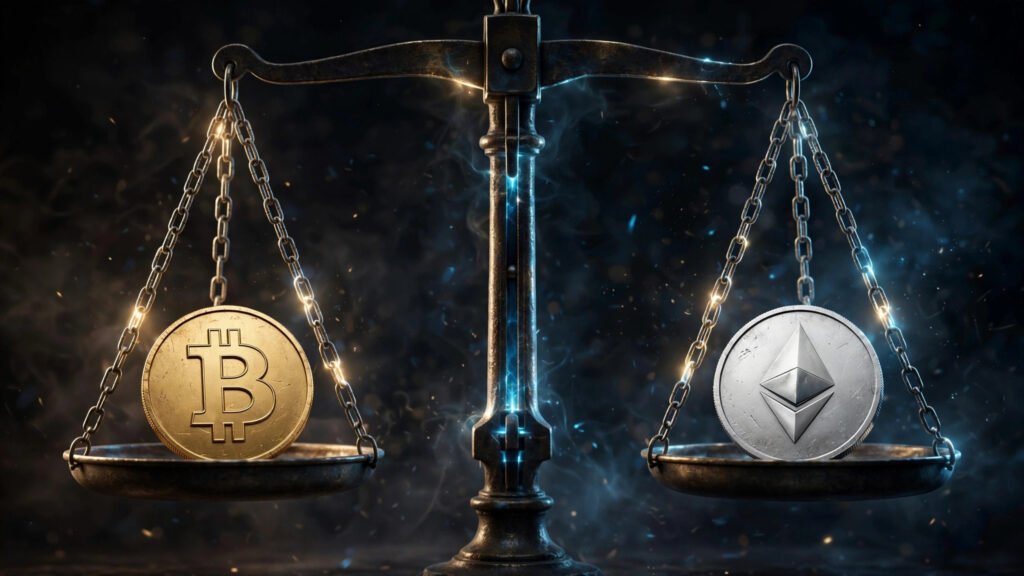
Bitcoin vs Ethereum in 2026: The Comparison That Actually Matters
Bitcoin and Ethereum are the two largest cryptocurrencies by an enormous margin, and comparing them is the single most useful exercise a crypto investor can do. As of October 19, 2026, bitcoin trades around $82,000 to $82,700 with a market cap near $1.63 to $1.64 trillion and dominance at roughly 60%, while ethereum trades around $2,400 to $2,450, roughly 49% below its peak of $4,953.73. Both assets have spot ETFs, both have institutional buyers, and both are down substantially from their highs. This article compares bitcoin and ethereum across the dimensions that actually determine portfolio fit — monetary design, technology, institutional demand, use cases, and risk — and gives you a framework for choosing between them instead of a tribal verdict.
A first principle: bitcoin and ethereum are not really competitors. They are different assets with different purposes, and comparing them is less like choosing between two tech stocks and more like choosing between gold and a technology platform. Bitcoin’s pitch is digital scarcity — the hardest money ever created. Ethereum’s pitch is programmable money — the settlement layer for a global decentralized financial system. That difference explains almost everything that follows, including why they behave differently in the same market conditions.
Bitcoin vs Ethereum at a Glance
| Metric (as of Oct 19, 2026) | Bitcoin (BTC) | Ethereum (ETH) |
|---|---|---|
| Price | ~$82,000-$82,700 | ~$2,400-$2,450 |
| Distance from peak | ~36% below $126,210 (Oct 2025 ATH) | ~49% below $4,953.73 peak |
| Market role | ~$1.63-1.64T; ~60% dominance | Second-largest crypto; far smaller share |
| Spot ETF flows | ~$229M weekly outflows (2nd straight week) | ~$320M weekly outflows; ~$955M in Oct (record) |
| Core narrative | Digital gold; scarce, neutral money | Programmable platform; DeFi and settlement layer |
| 2026 upgrade | No scheduled protocol upgrade | Glamsterdam (Q4 2026 target); Hoodi testnet Oct 26 |
| Corporate adoption | Treasury playbook; strategic-reserve debate | Bitmine holds ~6.02M ETH (~4.9% of supply) |
The table tells a compressed story. Bitcoin is far larger, closer to its high, and losing less ETF demand than ethereum in October’s risk-off stretch. Ethereum is deeper in its drawdown, seeing heavier outflows, but carries the more active development roadmap. Both are consolidating in a cautious market where the Fear and Greed Index reads 42 to 53. The right question is not “which is better” but “which risk am I being paid to take.”
Monetary Design: Digital Gold vs Programmable Money
Bitcoin’s monetary design is its entire thesis. Supply is hard-capped at 21 million coins, issuance halves roughly every four years, and the network’s social contract is to never change that. This simplicity is a feature: bitcoin does not try to do everything, which means it cannot break at everything. Investors who buy bitcoin are buying a credibly neutral, absolutely scarce monetary asset — the digital gold thesis — and the asset’s stubborn lack of ambition is what makes the promise believable.
Ethereum‘s monetary design is more flexible and, inevitably, more contested. Supply is not fixed; issuance adjusts with staking and usage, and the network’s roadmap has at various times made ETH deflationary or inflationary depending on activity. Ethereum holders accept this trade: in exchange for monetary purity, they get a network that can evolve, fund security through fees and staking rewards, and serve as the foundation for applications. The “ultrasound money” meme of the last cycle captured the ambition — ETH as money that improves — but the honest version admits the design is more complex and therefore carries more assumptions.
For a portfolio, the design difference translates to different risk profiles. Bitcoin’s risk is mostly market risk: will the world value digital scarcity more or less over time? Ethereum adds execution risk: will the network’s upgrades succeed, will its fee economics work, will competitors eat its lunch? That extra risk is why ETH typically falls harder than BTC in drawdowns — 49% below peak versus 36% — and why it tends to outperform in risk-on rallies. Understanding that trade-off is more useful than any price target.
Technology and Roadmaps: Stability vs Evolution
Bitcoin’s technology story in 2026 is deliberately boring, and its holders like it that way. The protocol changes slowly and conservatively; upgrades like Taproot and SegWit arrived years apart and with enormous caution. Development energy flows into layers and applications — Lightning for payments, Ordinals and Runes for on-chain experimentation — while the base layer stays simple and secure. For an asset whose value depends on the promise that the rules will never change, this conservatism is the product.
Ethereum’s technology story is the opposite: ambitious, continuous evolution. The 2026 headline is the Glamsterdam upgrade, which activated on the Sepolia testnet on October 6, 2026, moves to the Hoodi testnet on October 26, and targets mainnet in the fourth quarter of 2026. Glamsterdam brings enshrined proposer-builder separation — a fundamental redesign of how blocks are constructed — plus block-level access lists and revised gas pricing, all aimed at scaling and efficiency. It is serious engineering, and it continues ethereum’s pattern of reinventing its own internals to keep pace with demand.
Each approach has failure modes. Bitcoin’s conservatism risks stagnation if layers do not deliver, and its fee market remains a long-term question. Ethereum’s ambition risks upgrade complexity: each hard fork is a coordination event, and the history of crypto is littered with “technical upgrades” that underwhelmed. The research conversation around quantum risk — including discussions involving figures like Vitalik Buterin and Justin Drake on AI-optimized attacks — shows ethereum’s culture takes long-horizon threats seriously, but it also shows how much uncertainty lives in a system that keeps evolving.
Institutional Demand: ETFs, Treasuries, and the Big Buyers
Institutional demand is where bitcoin’s lead is clearest in 2026. Spot bitcoin ETFs, despite two weeks of outflows near $229 million weekly, hold an enormous base of assets and have made bitcoin a standard allocation. The average ETF holder’s cost basis near $81,500 sits just under the current price, which explains the jittery flows but also shows how deeply embedded bitcoin has become in portfolios. Add the corporate treasury wave and the strategic-reserve debate in Washington, and bitcoin’s institutional story is about integration into the financial system’s core.
Ethereum’s institutional story is real but rougher right now. Spot ETH ETFs have seen about $320 million in weekly outflows for three straight weeks, with October outflows near $955 million marking a record month — institutions are de-risking ethereum faster than bitcoin. On the corporate side, Bitmine’s accumulation of roughly 6,016,414 ETH, about 4.9% of total supply, shows that the treasury playbook is not bitcoin-exclusive; a listed company has made a massive, public, leveraged bet on ethereum specifically. That is conviction, but concentration cuts both ways: one holder with five percent of supply is a whale by any definition.
- Bitcoin ETFs: large installed base; recent outflows reflect cost-basis nerves more than rejection of the asset.
- Ethereum ETFs: record October outflows show heavier institutional de-risking of ETH in the current regime.
- Corporate treasuries: bitcoin’s treasury wave is broader; ethereum’s is concentrated, led by Bitmine’s ~4.9% of supply.
- Staking: BitGo opening Lido staking to eligible US clients shows ETH’s yield story reaching regulated channels.
- Takeaway: institutions treat BTC as the default and ETH as the higher-conviction, higher-risk satellite.
Use Cases and Where the Growth Comes From
Bitcoin’s growth story is adoption as money and as a reserve asset. Individuals buy it as savings technology, companies hold it as treasury insurance, funds buy it as a macro hedge, and governments debate holding it as a strategic reserve. Each new category of holder expands the buyer base without requiring bitcoin to do anything new. The use case is the holding itself — simple, and historically very powerful.
Ethereum’s growth story is adoption as infrastructure. Every DeFi protocol, stablecoin transfer, tokenized asset, and AI-agent payment rail that settles on ethereum or its layer-twos generates demand for ETH as gas and as economic security. Cardano joining the x402 SDK for AI agent payments in September is a reminder that the programmable-money race is competitive, but ethereum remains the deepest ecosystem. The flip side: ethereum’s value depends on that ecosystem staying vibrant, while bitcoin’s depends mostly on the world continuing to want scarce money. Infrastructure demand is potentially larger but far less certain.
Risk Comparison: Which Asset Punishes Which Mistakes
The risks are mirror images. Bitcoin’s main risk is that the digital-gold thesis stalls: that after a 36% drawdown, demand never returns, ETF flows keep leaking, and the asset grinds sideways for years while newer narratives capture attention. It is the risk of irrelevance through boredom, not of technical failure. Volatility is real — bitcoin briefly fell below $80,000 within the last month — but the protocol itself is not going to break.
Ethereum’s risks include everything bitcoin’s plus technology and competition. A delayed or buggy Glamsterdam, continued fee and scaling pressure, or a rival platform capturing the next wave of developers would hit ETH harder than BTC. The 49% drawdown from peak already reflects some of this discount. On the other hand, ethereum’s upside in a risk-on regime is typically larger precisely because it fell further and carries more optionality on innovation.
For portfolio construction, the practical implication is about roles. Bitcoin is the anchor: lower volatility (for crypto), deepest liquidity, the asset institutions buy first. Ethereum is the growth engine: higher beta, real yield via staking, exposure to the application layer’s upside, and correspondingly deeper drawdowns. A portfolio of only bitcoin is concentrated in the monetary thesis; a portfolio of only ethereum is concentrated in the technology thesis. Most long-horizon investors who hold both are really holding two different bets about the future, and sizing each by conviction and risk tolerance.
| Risk dimension | Bitcoin | Ethereum |
|---|---|---|
| Drawdown from peak (Oct 2026) | ~36% | ~49% |
| Technical risk | Low; protocol rarely changes | Higher; upgrades like Glamsterdam are complex |
| Competition risk | Low; no credible “second bitcoin” | Higher; other smart-contract platforms compete |
| Regulatory risk | Lowest in crypto; ETF + reserve debate | Low but higher than BTC; staking scrutiny |
| Upside beta | Market anchor; moves first, moves less | Higher beta; outperforms in risk-on rallies |
Ethereum’s 2026 Headwinds in Focus: Outflows, Competition, and Concentration
Ethereum’s deeper drawdown deserves an honest autopsy, because it explains much of the gap between the two assets. Start with flows: record October ETF outflows near $955 million did not happen in a vacuum. ETH has spent 2026 fighting a narrative problem — fee revenue across the broader ecosystem has dispersed to layer-two networks, leaving some investors asking what exactly accrues to the base asset. Add the general risk-off regime, where institutions de-risk the higher-beta asset first, and ethereum’s 49% drawdown overstates neither its problems nor its potential; it prices both.
Competition is the second headwind. Smart-contract platforms competing for developers and applications have multiplied, and the action in any given quarter — Cardano’s push into AI-agent payments via the x402 SDK in September is a small example — tends to fragment attention and liquidity. Ethereum’s defense is depth: the largest developer community, the deepest DeFi liquidity, and the most battle-tested infrastructure. Depth has won every platform war so far in crypto, but “so far” is doing work in that sentence.
Concentration is the third. Bitmine’s roughly 6 million ETH — approaching 5% of supply — is simultaneously ethereum’s loudest institutional endorsement and one of its largest single-entity overhangs. If that position is held with conviction through the cycle, it is a permanent float reduction. If it is ever unwound under pressure, it becomes a supply event. Bitcoin has its own whale concentrations, but its corporate and fund holders are more diversified as a class, which is part of why its drawdown, at 36%, has been shallower and steadier.
The Dual-Asset Portfolio: Sizing BTC and ETH Together
If you hold both assets, the real question is sizing, and sizing should follow role rather than hype. A common institutional-style approach treats bitcoin as the core position — the majority of the crypto allocation — and ethereum as a satellite sized according to your conviction in the application-layer thesis and your tolerance for the deeper drawdowns ETH reliably delivers. Rebalancing rules matter more than the exact split: when ETH outperforms for a season and doubles its portfolio weight, trimming back toward target enforces the discipline of selling strength; when it lags and shrinks, adding back enforces buying weakness. Without a rule, the portfolio quietly becomes a momentum bet.
Tax and custody practicalities belong in the sizing conversation too. Staking ethereum introduces yield but also lockups, counterparty or protocol considerations, and in many jurisdictions distinct tax treatment of rewards. Bitcoin held in self-custody or via an ETF is operationally simpler. None of these considerations decide the BTC-versus-ETH question by themselves, but together they explain why bitcoin tends to be the asset people hold the longest and why ethereum tends to be the asset people actively manage. Your portfolio is allowed to be boring about the first and deliberate about the second.
The final word belongs to correlation honesty. In sharp sell-offs, BTC and ETH fall together — diversification between them cushions relative pain rather than preventing it, as October’s simultaneous ETF outflows from both funds demonstrated. Holding both is a bet on two theses, not a hedge. Size the combined position as one crypto allocation first; split it second.
The Upgrade Question: What If Glamsterdam Disappoints?
Every roadmap-based investment case needs its failure mode spelled out, and ethereum’s is the possibility that Glamsterdam, for all its engineering merit, does not move the needle investors hope for. The history of crypto upgrades is full of technically successful launches that arrived with a shrug from the market, because expectations had been priced in months earlier or because users did not experience the promised improvements in ways they could feel. Glamsterdam’s features — enshrined proposer-builder separation, block-level access lists, revised gas pricing — are architecturally significant but largely invisible to end users, which raises the classic risk: a brilliant upgrade that the price ignores because the market had already priced it, or because cheaper fees accrue to layer-two users rather than ETH holders. The counterweight is that ethereum’s upgrade machine is precisely what has kept it relevant through multiple cycles, and underestimating shipping teams is its own expensive habit. The balanced position treats the upgrade as a real, positive catalyst with a capped, conditional effect: supportive for the thesis, not decisive for the price.
The Bottom Line: Match the Asset to the Job
The bitcoin-versus-ethereum debate persists because both sides are defending real truths: bitcoin is the most credible scarce money the digital age has produced, and ethereum is the most credible programmable settlement layer. The framework that resolves the argument is the job you assign each asset. For wealth preservation and simple, deep, institutional-grade exposure, bitcoin does its job with less to go wrong. For exposure to the growth of the on-chain economy, with staking yield as a partial offset for the risk, ethereum earns its place despite the deeper drawdowns. Decide the job first — the asset follows naturally.
Frequently Asked Questions
Is bitcoin or ethereum better in 2026?
Neither is objectively better; they are different assets. Bitcoin is larger, closer to its all-time high, and the institutional default, while ethereum is deeper in its drawdown but carries an active upgrade roadmap with Glamsterdam targeting mainnet in Q4 2026. The right choice depends on whether you want monetary scarcity or technology-platform exposure.
Why is ethereum down more than bitcoin?
Ethereum trades about 49% below its peak versus bitcoin’s roughly 36%, a typical pattern: ETH has higher beta, meaning it falls harder in risk-off periods and rises faster in risk-on ones. Heavier institutional de-risking — record October ETF outflows near $955 million — has added to the pressure on ETH specifically.
What is the Glamsterdam upgrade?
Glamsterdam is ethereum’s 2026 network upgrade, activated on the Sepolia testnet on October 6, 2026, heading to Hoodi on October 26 with mainnet targeted for Q4 2026. It introduces enshrined proposer-builder separation, block-level access lists, and revised gas pricing, aimed at scaling and efficiency.
Should I hold both bitcoin and ethereum?
Many long-horizon investors do, treating bitcoin as the anchor and ethereum as the growth position. The two assets diversify across theses — digital scarcity versus programmable infrastructure — though they remain highly correlated in sharp market moves. Sizing should reflect your conviction, risk tolerance, and time horizon, not anyone’s prediction.
Does ethereum staking make it better than bitcoin?
Staking gives ETH a native yield that bitcoin lacks, which appeals to income-oriented holders, and regulated access is expanding, such as BitGo opening Lido staking to eligible US clients. But yield comes with its own risks — lockups, slashing, and smart-contract exposure — so it is a trade-off, not a free advantage.
Which is safer for a beginner?
Bitcoin is generally considered the safer starting point: simpler thesis, deepest liquidity, most institutional acceptance, and the smallest drawdown of the two in 2026. Beginners who add ethereum later usually do so after understanding staking, upgrades, and the higher volatility that comes with them.
This article is for informational purposes only and is not investment advice.