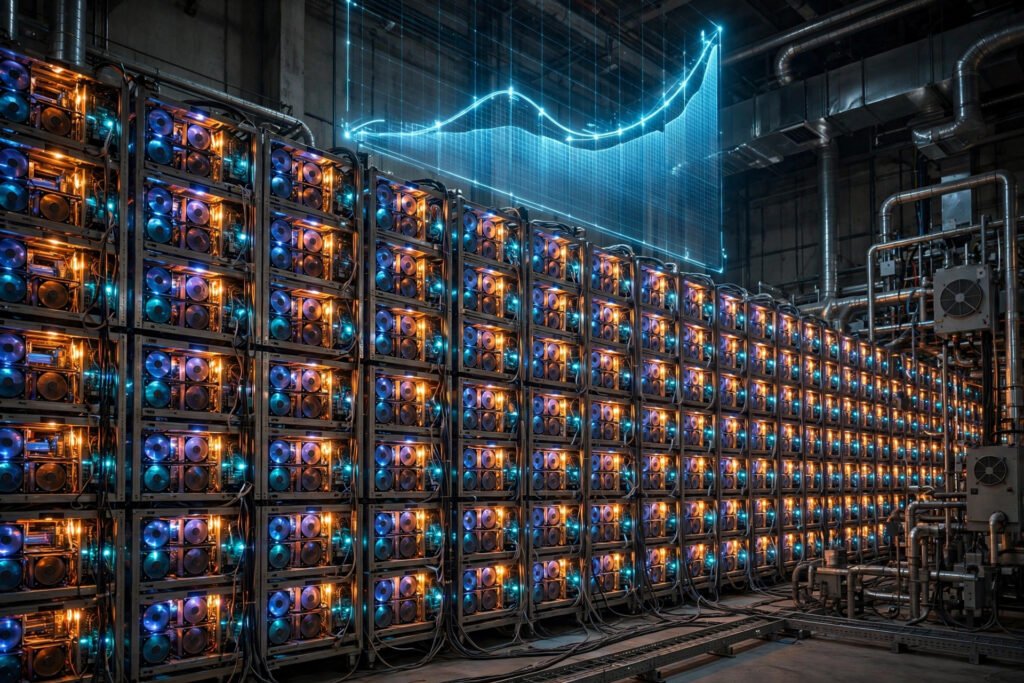
Bitcoin Hashrate Keeps Making Record Highs in 2026
Bitcoin‘s price chart gets the headlines, but the network’s most impressive chart in 2026 may be its hashrate. Through the year, the total computing power securing the bitcoin network has climbed to successive record highs, measured in hundreds of exahashes per second — hundreds of quintillions of cryptographic guesses every second, all competing to produce the next block. Remarkably, that investment has continued even as bitcoin’s price, near $82,500 as of October 19, 2026, sits roughly 36% below its $126,210 all-time high. This article explains what hashrate is, why it keeps breaking records, how the difficulty adjustment keeps the system balanced, and what rising hashrate really means — and does not mean — for bitcoin’s security and your holdings.
Hashrate is the pulse of bitcoin‘s security model. Every other claim about bitcoin — its scarcity, its censorship resistance, its finality — ultimately rests on the fact that an enormous amount of real-world energy and hardware stands behind the ledger, making it prohibitively expensive to rewrite. When hashrate sets records, that moat gets deeper. Understanding hashrate is therefore not a miner’s niche interest; it is the foundation under every other bitcoin thesis.
What Is Hashrate, in Plain English?
Bitcoin mining is a guessing game. Miners bundle pending transactions into a candidate block and repeatedly hash it — run it through the SHA-256 cryptographic function — hoping the output falls below a target value set by the network. Each guess is a hash. Hashrate is simply the number of guesses per second. One exahash per second (EH/s) means a quintillion guesses per second, and bitcoin’s network total is in the hundreds of EH/s — numbers so large they stop being intuitive, which is rather the point.
Why guessing? Because it makes cheating expensive in a way nothing else can. To add blocks, you must burn real computation. To rewrite history — say, to reverse a confirmed payment — you must out-guess the entire honest network continuously, controlling more than half of the global hashrate. The network’s hashrate is thus directly convertible into a security statement: this is how much honest work an attacker must outspend. Nobody “guards” bitcoin; the math and the megawatts do.
- Hash: the output of running block data through SHA-256; miners need an output below the network’s target.
- Hashrate: guesses per second, from a single machine’s terahashes to the network’s hundreds of exahashes.
- Proof of work: the system where demonstrated computation earns the right to propose blocks and claim rewards.
- Difficulty: the adjustable target that keeps blocks arriving roughly every ten minutes regardless of hashrate.
- Mining reward: block subsidy plus transaction fees, the revenue that pays for all that security.
The Difficulty Adjustment: Bitcoin’s Self-Balancing Act
If hashrate doubles, blocks would arrive twice as fast — unless the network compensates. It does, through the difficulty adjustment, one of bitcoin’s most elegant mechanisms. Every 2,016 blocks — roughly two weeks — the protocol measures how long those blocks actually took and retargets the difficulty: faster than ten minutes per block, difficulty rises; slower, it falls. The result is a system that self-corrects no matter how much hardware joins or leaves.
The adjustment is why record hashrate does not mean record block production, and why bitcoin’s monetary schedule stays predictable: issuance depends on block count, not on mining power. It is also why mining is a relentlessly competitive industry. When prices rise and new miners pile in, difficulty follows them up, compressing everyone’s margins back toward equilibrium. When price falls, as it has through 2026’s drawdown, the weakest miners face a vice: revenue per unit of hashrate declines while difficulty keeps grinding upward on the back of more efficient competitors. Record hashrate alongside a 36% price decline means the industry is in an arms race where only efficiency survives.
There is a security silver lining to that brutality. A difficulty ratchet driven by efficiency means the network’s security increasingly runs on the newest silicon and the cheapest power contracts on earth. Attacking bitcoin does not get easier as the asset matures; every cycle, the honest network rebuilds itself with better machines.
Why Is Hashrate Rising While Price Is Down?
The apparent paradox — record hashrate, depressed price — dissolves once you understand mining’s time lags. Mining facilities are planned and financed quarters or years ahead: power contracts signed, buildings constructed, machines ordered in bulk. Hardware ordered during the optimism of bitcoin’s run to $126,210 arrives and plugs in regardless of the spot price on delivery day. Sunk infrastructure gets deployed because the marginal cost of running it, where power is cheap, is often still below the revenue it earns.
Capital markets tell the same story of an industry investing through the drawdown. Hut 8, one of the sector’s major miners, secured a $260 million refinancing deal in 2026 — the kind of financing that funds expansion and fleet upgrades rather than retreat. Professional miners think in cycles: deploying efficient machines during weak prices, when competition for power and hardware softens, positions them to harvest outsized margins when price recovers. Hashrate records in a bear phase are the footprint of that strategy being executed across the industry simultaneously.
Efficiency gains complete the picture. Each new generation of ASIC hardware produces more hashes per watt than the last, so total hashrate can rise even if the industry’s total energy use rises more slowly. When old machines retire to regions with stranded, ultra-cheap energy and new machines take the premium sites, hashrate compounds. The metric measures security and competition, not the industry’s mood — and by that measure, 2026’s miners are competing harder than ever.
| Driver | How it lifts hashrate | Time horizon |
|---|---|---|
| Pre-committed capex | Facilities and machines ordered in bull phases deploy on schedule | Quarters to years |
| ASIC efficiency | New hardware generations produce more hashes per watt | Continuous |
| Cheap/stranded energy | Retired machines stay profitable where power is nearly free | Ongoing |
| Financing access | Refinancings and capital raises fund expansion (e.g., Hut 8’s $260M) | Cyclical |
| Competitive dynamics | Standing still while rivals upgrade means losing share of rewards | Continuous |
What Record Hashrate Means for Bitcoin’s Security
The security implication is direct: attacking bitcoin has never been more expensive. A 51% attack — controlling a majority of hashrate to rewrite recent history or double-spend — would require acquiring and powering hardware comparable to a significant fraction of the entire global fleet, an undertaking measured in billions of dollars of capital plus a small nation’s electricity. And even success buys limited damage: an attacker can disrupt recent transactions and censor, but cannot forge signatures, steal coins from arbitrary wallets, or change the 21 million supply cap. Nodes would reject invalid blocks regardless of how much work backs them.
Record hashrate also strengthens subtler security properties. More hashrate spread across more facilities and jurisdictions means no single government, company, or power grid failure can threaten the network’s operation. Confirmation confidence deepens: the standard advice that high-value transfers wait for several confirmations rests on the assumption that overwhelming the accumulated work is infeasible, an assumption that record hashrate keeps reinforcing. And there is an insurance-like reading for holders: every bitcoin you own is protected by the most expensive-to-attack monetary network in history, and that protection is compounding.
Honesty requires the counterpoints. Hashrate concentration in mining pools — where individual miners coordinate block templates — is a real and debated soft spot, distinct from hardware ownership. Energy sourcing remains a live environmental debate, even as the industry’s use of stranded and renewable power grows. And hashrate is a trailing indicator of investment, not a guarantee: it can fall if prices stay depressed long enough, as brief drawdowns in mining activity during past bear markets showed. Security today is at record levels; projecting it forward still depends on mining remaining profitable enough to sustain the fleet.
Hashrate and the Security Budget Debate
Record hashrate sits at the center of a serious long-term question: who pays for bitcoin’s security when the block subsidy runs out? Miners’ revenue comes from the subsidy plus transaction fees. The subsidy halves every four years by design, trending toward zero, which means fees must eventually fund the security that today is mostly subsidy-paid. Critics worry that fee revenue alone might someday prove too thin, letting hashrate — and security — sag. Supporters counter that bitcoin’s growing value and settlement demand will generate the needed fees, pointing to fee-mania episodes as evidence that block space demand can spike enormously when the network is in demand.
The 2026 data feeds both sides. Hashrate at record highs shows miners investing as if the future revenue will be there — an industry voting with billions in capital. The current fee environment, in a quiet market with cautious sentiment (Fear and Greed at 42 to 53), shows the gap: fees alone today would fund a fraction of the present security spend. The debate will not resolve this year or this cycle; what matters for holders is that the people with the most information about mining economics are currently betting on growth, not decline.
There is also a connection between hashrate and the broader 2026 market story. ETF outflows of about $229 million in consecutive weeks and a bitcoin price down 36% from its peak describe weak demand-side sentiment. Hashrate describes the supply side of security spending compounding regardless. Bitcoin has always been this two-sided organism: price sentiment that whipsaws quarterly, and industrial infrastructure that grinds in one direction for years. Watching only the price chart misses half the organism.
What Record Hashrate Does NOT Mean
Because hashrate correlates with price over long periods, a folk belief says rising hashrate predicts rising price — “price follows hashrate.” The truth is closer to the reverse: price drives hashrate, with a lag, because mining investment follows profitability. Miners deployed through 2026 because of decisions made when bitcoin was far more expensive. Treating hashrate as a buy signal mistakes an echo for a voice.
Record hashrate also does not mean mining is easy money. Rising difficulty compresses margins relentlessly; the same record hashrate that secures your coins is bankrupting inefficient miners whose costs exceed revenue at $82,500. Nor does hashrate measure decentralization by itself — that requires looking at pool distribution, hardware ownership, and geography together. And finally, hashrate says nothing directly about adoption: it is a supply-side security metric, not a count of users or transactions.
- Not a price signal: hashrate follows price and profitability with a lag; it does not lead them.
- Not easy profits: record difficulty means record competition; inefficient miners lose money at record pace too.
- Not the whole decentralization story: pool concentration and geography must be examined alongside raw hashrate.
- Not an adoption metric: it measures security spend, not users, wallets, or payment volume.
- Still meaningful: as a pure measure of “how expensive is bitcoin to attack,” it has never been higher.
How to Follow Hashrate Like an Analyst
If you want hashrate in your research toolkit, a few practices separate signal from noise. First, use smoothed averages — the standard is the 7-day or 14-day moving average of estimated hashrate — because raw daily estimates swing wildly with pure luck in block discovery. Second, watch difficulty adjustments: a long streak of upward adjustments confirms real hardware growth, while hashrate estimates alone can mislead for days. Third, pair hashrate with miner economics — revenue per unit of hashrate — to judge whether the trend is sustainable or running on fumes.
Fourth, watch miner behavior around price stress. In 2026’s drawdown, miners refinancing and expanding (as with Hut 8’s $260 million deal) paints a different picture than miners liquidating treasuries and curtailing operations. Fifth, remember the only question hashrate ultimately answers: is the network harder or easier to attack than before? In 2026 the answer, emphatically, is harder — and for an asset whose entire proposition rests on being incorruptible, that is the metric doing its job.
Mining Geography: Where the Hashrate Lives and Why It Matters
Record hashrate is not evenly spread across the planet, and its geography is a security feature in itself. Industrial mining concentrates where energy is cheapest and most stranded — hydroelectric regions with surplus power, natural-gas fields where flared gas would otherwise burn unused, geothermal zones, and grids that pay generators to curtail. That chase for cheap electrons has distributed bitcoin’s security across dozens of jurisdictions and multiple continents, which means no single government’s policy, no single grid failure, and no single disaster can take the network offline. Mining migrates toward wasted energy the way water flows downhill, and every migration makes the network harder to coerce.
Geography also explains the industry’s political maturation. Mining at industrial scale means facilities, jobs, and grid relationships, which is why miners increasingly feature in energy-policy debates — flexible loads that can power down in seconds during grid emergencies are genuinely valuable to grid operators. Whatever one concludes about bitcoin’s energy debate, the geographic spread behind 2026’s record hashrate is the strongest structural answer to the oldest fear about bitcoin: that someone, somewhere, could simply switch it off. There is no longer anywhere to aim that switch.
The Long View: Hashrate Records and the Road to 2028
Zoom out and 2026’s hashrate records are one frame in a longer film. Bitcoin’s hashrate has risen through every era — through bans, bear markets, halvings, and obituaries — because the incentive structure rewards exactly one behavior: find cheaper energy, deploy better machines, secure the network, earn the reward. The next halving, due in 2028, will cut the block subsidy again and stress-test that structure once more: miners with high costs will fail, difficulty will adjust, fees will matter more, and the surviving industry will be leaner and more efficient. If history is a guide, hashrate will wobble around the transition and then resume its grind upward, because it always has — not by magic, but because the economics of the world’s cheapest energy keep pointing at the same protocol. Holders watching the 2028 horizon can treat each new hashrate record between now and then as a progress report on that bet.
A Quick Sanity Check on Hashrate Numbers
One caution for anyone quoting hashrate: it is estimated, not measured. Nobody polls the world’s miners; analysts infer hashrate from how fast blocks are arriving relative to difficulty, which means short-window estimates bounce around with pure statistical luck. A “record” printed by a single fast day may be noise, which is why serious tracking uses weekly averages and difficulty adjustments as confirmation. When you see hashrate records reported in 2026, the meaningful version is the sustained trend — weeks of elevated averages with upward difficulty adjustments confirming real hardware — and it is that trend, not any single day’s print, that carries the security implications this article describes.
Frequently Asked Questions
What is bitcoin hashrate?
Hashrate is the total number of cryptographic guesses per second that miners worldwide are performing to compete for the next bitcoin block. It is measured in hashes per second, scaling from terahashes to exahashes. Higher hashrate means more computation — and therefore more cost — stands between an attacker and any attempt to rewrite bitcoin’s history.
Why is bitcoin hashrate at record highs if the price is down?
Because mining investment lags price. Facilities, power contracts, and hardware are committed quarters or years ahead, and efficient machines ordered during expensive-bitcoin periods keep deploying. New ASIC generations also produce more hashes per watt, and well-financed miners, like Hut 8 with its $260 million refinancing, expand through drawdowns to gain share.
Does higher hashrate make bitcoin more secure?
Yes, directly. A higher hashrate raises the capital and energy cost of a 51% attack, deepens confidence in transaction finality, and usually reflects a more geographically distributed mining base. It does not solve every security question — pool concentration and energy debates continue — but on the core metric of attack cost, record hashrate means record security.
What is the difficulty adjustment?
Every 2,016 blocks, roughly two weeks, bitcoin’s protocol retargets mining difficulty so blocks keep arriving about every ten minutes on average. If blocks came too fast, difficulty rises; too slow, it falls. This self-balancing keeps bitcoin’s issuance schedule predictable no matter how much mining power joins or leaves the network.
Does rising hashrate mean bitcoin’s price will rise?
No. The causality mostly runs the other way: price and profitability drive mining investment, with hashrate following after a lag. Record hashrate in 2026 partly reflects decisions made when bitcoin traded far above its current ~$82,500. Hashrate is a security and industry-health metric, not a price-prediction tool.
Who pays for bitcoin’s security in the long run?
Today, mostly the block subsidy, which halves every four years by design. Over time, transaction fees must fund a growing share of miners’ revenue. Whether fee demand will fully replace the subsidy is bitcoin’s biggest open economic question — one that record hashrate suggests miners, voting with their capital, currently answer optimistically.
This article is for informational purposes only and is not investment advice.