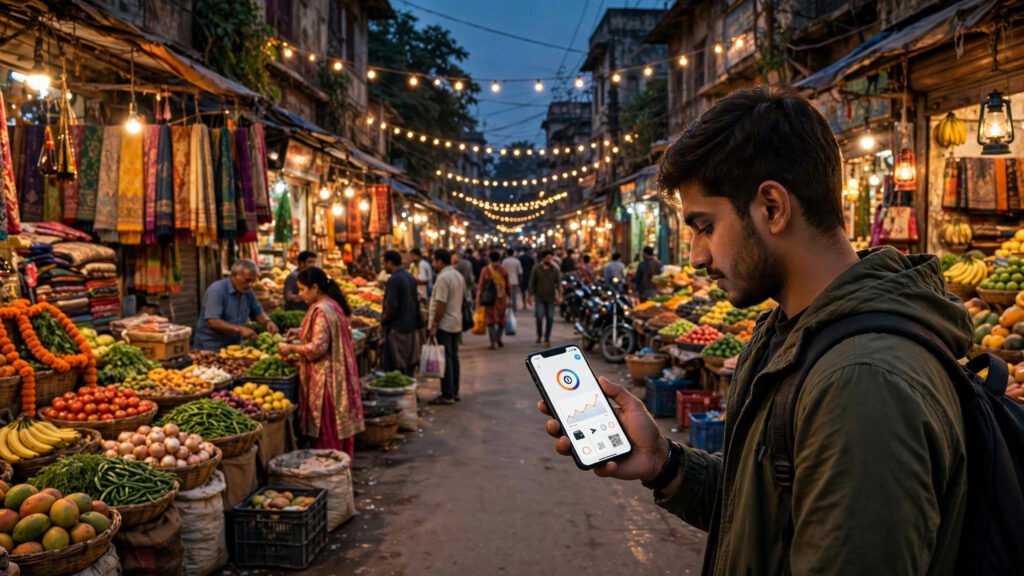
Crypto adoption in Pakistan and India: the 2026 picture
When people picture crypto adoption, they usually think of Wall Street trading desks and Silicon Valley startups. But some of the most interesting crypto adoption stories of 2026 are playing out in Pakistan and India — two countries where cryptocurrency arrived not through institutions, but through ordinary people solving ordinary problems: expensive remittances, unstable savings, and a young, mobile-first population that treats the smartphone as its bank. As of October 19, 2026, grassroots crypto use in South Asia remains one of the industry’s most important — and most misunderstood — growth stories.
This article takes an honest look at how crypto is actually used in Pakistan and India, what drives adoption, where the regulatory gray zones are, and what newcomers in the region should know. No hype, no invented statistics — just the forces shaping the market and the practical realities on the ground.
Why South Asia adopted crypto from the ground up
In the West, crypto adoption was largely top-down: exchanges launched, venture capital flowed in, and eventually ETFs arrived. In Pakistan and India, the pattern reversed. Adoption was bottom-up — driven by individuals who found that crypto solved problems their local financial systems did not.
Several structural factors explain why:
- Young, connected populations. Both countries have huge populations under 35 who grew up with smartphones and are comfortable with digital-first money. The learning curve that intimidates older savers in developed markets barely exists here.
- Mobile-first finance. For millions, the phone is the first and only financial device. Mobile wallets and payment apps normalized digital money years ago; crypto is a smaller conceptual leap than it is for someone used to bank branches.
- Expensive traditional rails. Sending money across borders through banks or money-transfer operators can cost a meaningful percentage of the transfer and take days. Crypto transfers settle in minutes at a fraction of the cost — a difference that matters enormously when the amounts are a family’s monthly budget.
- Currency pressure. When local currencies lose value, people look for alternatives. Bitcoin‘s fixed supply of 21 million coins and dollar-pegged stablecoins offer options that simply do not exist in the domestic financial system.
- Freelance and remote work. South Asia’s massive freelance workforce — developers, designers, writers — increasingly gets paid in crypto by international clients, bypassing slow and costly banking channels entirely.
Remittances: crypto’s killer use case in the region
Remittances — money sent home by workers abroad — are a lifeline for both economies, running into the tens of billions of dollars annually. The traditional corridor is expensive: fees, unfavorable exchange rates, and multi-day settlement eat into every transfer.
Crypto offers a fundamentally different model. A worker abroad buys a dollar-pegged stablecoin like USDT — the world’s largest stablecoin at roughly $185 billion in circulation — sends it to a family member’s wallet in minutes, and the recipient converts it to local currency through a local exchange or peer-to-peer trade. The total cost is typically a small fraction of traditional channels, and settlement happens in minutes rather than days.
This is not theoretical. Across Pakistan and India, stablecoin-based remittance flows have become one of the most practical, least speculative uses of cryptocurrency anywhere in the world. The users involved are not “investors” in any meaningful sense — they are families moving money, and they care about speed and cost, not price charts.
Inflation hedging: savings that hold their value
For savers in countries with volatile currencies, crypto serves a second function: a way out. Holding savings in a depreciating currency is a guaranteed slow loss. Bitcoin — volatile in the short term but with a hard-capped supply — and dollar-pegged stablecoins give people access to savings instruments their domestic systems do not provide.
This dynamic intensified through 2026. With Bitcoin trading near $82,000 in October — about 36% below its all-time high of $126,210 — the asset remains far more volatile than cash. But for someone watching their local currency slide year after year, even volatile crypto can look like the more honest store of value. Stablecoins fill the gap for the risk-averse: dollar exposure without a dollar bank account.
The honest caveat: crypto volatility cuts both ways, and stablecoins carry their own risks — issuer risk, depegging risk, and regulatory risk. None of this is a safe savings account. But understanding why people make this choice matters more than judging it.
Pakistan: adoption ahead of regulation
Pakistan’s crypto story is one of adoption running ahead of policy. For years, the central bank discouraged banks from dealing with crypto businesses, while ordinary Pakistanis traded, held, and transacted in growing numbers — often through peer-to-peer markets and offshore exchanges.
The result is a market that is large, active, and structurally informal. P2P trading — where buyers and sellers transact directly, often settling in local currency through bank transfers or mobile money — became the backbone of Pakistani crypto activity. This works, but it carries real risks: P2P fraud, where one side of a trade disappears after receiving funds, is one of the most common ways newcomers lose money.
Regulatory signals have shifted over time, and the honest summary as of late 2026 is that the framework remains in flux. Anyone operating in Pakistan should verify the current rules through official channels before transacting — the gap between “widely practiced” and “formally permitted” is exactly where users get hurt.
India: the world’s biggest crypto market by users
India’s relationship with crypto has been a rollercoaster of court battles, banking restrictions, and explosive grassroots growth. The country’s crypto user base is routinely described as among the largest in the world — a function of simple arithmetic: 1.4 billion people, cheap data, and a deep developer and trading culture.
India’s regulatory journey has been genuinely turbulent. The central bank once barred banks from serving crypto businesses; the Supreme Court overturned that ban; tax policy then made trading expensive; and the framework has continued to evolve since. Through it all, Indian users kept trading, building, and adopting — a testament to how little top-down policy has mattered to bottom-up demand.
What distinguishes India is the developer layer. Indian engineers are disproportionately represented in global crypto and Web3 teams, and domestic startups have built exchanges, wallets, and infrastructure used worldwide. Adoption in India is not just consumption — it is production. That matters for the long term: countries that build the infrastructure tend to capture more of the value.
As with Pakistan, the honest advice is the same: rules shift, and users should check current regulations through official sources rather than relying on social media summaries. Tax treatment of crypto in India has real consequences — ignorance of it is expensive.
The regulatory gray zone: what it actually means for users
“Regulatory uncertainty” sounds abstract. In practice, it means concrete things:
- Banking friction. When banks are discouraged from serving crypto businesses, users get pushed toward P2P markets and offshore platforms — which are harder to vet and offer less recourse if something goes wrong.
- Tax ambiguity. Unclear or punitive tax treatment pushes activity underground, where it is harder to measure, protect, and legitimize.
- Enforcement risk. The gap between tolerated practice and written law creates situations where ordinary users can face account freezes or legal trouble through no fault of their own.
- Scam cover. Gray zones are where scammers thrive. Fraudulent “investment schemes” exploit the fact that legitimate crypto activity already looks informal, making it harder for newcomers to tell the difference.
The global trend, however, is toward clarity. In the United States, SEC Chair Paul Atkins proposed rules in October 2026 letting funds hold crypto, and the CLARITY Act‘s market-structure vote advanced — signals that major economies are moving from prohibition debates to rule-writing. Regulatory clarity anywhere tends to ripple outward: it gives other jurisdictions templates to copy and reduces the perceived risk of engagement.
How people actually use crypto in Pakistan and India
Strip away the speculation narrative and the real usage patterns are refreshingly practical:
| Use case | Who | Why it works |
|---|---|---|
| Remittances via stablecoins | Migrant workers and families | Minutes vs. days, fraction of traditional fees |
| Freelance payments | Developers, designers, remote workers | Direct international payment without banking friction |
| Savings in stablecoins/BTC | Middle-class savers | Alternative to depreciating local currency |
| Trading | Young retail traders | 24/7 markets, low entry barriers |
| Building (India especially) | Developers, startups | Global demand for Web3 engineering talent |
Notice what is not on the list: hardly anyone in these markets is buying coffee with Bitcoin. The “payments” narrative that dominates Western crypto marketing is mostly irrelevant here. The real adoption is in value transfer and value storage — the unglamorous plumbing of money.
Risks specific to the region
Newcomers in Pakistan and India face risks that Western guides rarely mention:
- P2P fraud. The most common local scam: a buyer sends a fake payment screenshot, or a seller vanishes after receiving funds. Always use platforms with escrow and dispute resolution, and never release crypto before confirming actual receipt of payment.
- Fake exchanges and apps. Cloned apps and lookalike websites harvest logins and deposits. Download only from official sources and verify URLs character by character.
- “Guaranteed return” schemes. Any platform promising fixed daily or monthly crypto profits is a scam. This is the single most reliable red flag in the industry.
- SIM-swap and account takeover. With phone numbers tied to financial accounts everywhere, SIM-swapping is a live threat. Use authenticator apps, not SMS, for 2FA.
- Regulatory whiplash. Rules can change with a court ruling or a central bank circular. Keep records of your transactions — dates, amounts, counterparties — so you can demonstrate compliance whatever the rules become.
What would unlock the next wave
Three things would transform South Asian crypto adoption from impressive to historic. First, clear, stable regulation — not necessarily permissive, just predictable. Businesses and users can work with strict rules; they cannot work with shifting ones. Second, banking integration — on-ramps and off-ramps through the formal financial system would drain the P2P gray market of its fraud and friction overnight. Third, local stablecoin infrastructure — deeper liquidity in dollar stablecoins like USDT ($185B) paired with efficient local-currency conversion.
None of these require new technology. They require policy decisions. And the global direction — from the US market-structure bills to the October 2026 SEC proposals — suggests the policy window is opening, not closing.
Practical guidance for newcomers in Pakistan and India
- Start with education, not investment. Understand what Bitcoin, Ethereum, and stablecoins actually are before spending anything. If you cannot explain a coin in one sentence, do not buy it.
- Use reputable platforms with escrow for any P2P trading, and check proof-of-reserves and audit history for exchanges.
- Start small. An amount you can afford to lose completely is the right first size. Crypto volatility is real — Bitcoin is 36% below its all-time high as of October 2026.
- Secure everything: unique passwords, authenticator-app 2FA, withdrawal whitelists, and a hardware wallet once holdings become meaningful.
- Keep records. Transaction logs protect you under any future tax or regulatory regime.
- Verify the current rules through official government and central bank channels — not influencers, not forwarded messages.
The generational divide: who adopts crypto and why
Crypto adoption in Pakistan and India is overwhelmingly a young person’s game, and the reasons go deeper than tech comfort. For the under-35 generation, the traditional financial system never really worked for them in the first place. Bank accounts with high minimum balances, loan applications requiring collateral they do not have, and investment products gated behind paperwork and minimums — the old system offered this generation very little. Crypto’s permissionless nature is not an ideology to them; it is simply the first financial system that let them in without asking for credentials they lack.
This creates a genuine generational divide in how crypto is perceived. Older savers tend to see it through the lens of speculation and risk — which is fair, given the volatility. Younger users see it through the lens of access: a dollar savings account via stablecoins, a way to receive freelance payments from abroad, a market that trades 24/7 and does not require a broker’s permission. Both views are true simultaneously, and any honest account of adoption has to hold both.
The divide also shows up in how each generation uses crypto. Older, wealthier users who do participate tend to treat Bitcoin as a portfolio diversifier — a small allocation alongside stocks and property. Younger users treat crypto as infrastructure: the rails for their income, their savings, and their cross-border lives. The first group asks “will the price go up?” The second asks “will the transfer arrive?” That second question is the healthier foundation for long-term adoption.
Education efforts in the region need to respect this split. Telling a 24-year-old freelancer that crypto is “too risky” lands flat when their alternative is watching savings erode in a depreciating currency. The useful conversation is not “crypto versus no crypto” — it is “which crypto uses are sensible, which are gambling, and how do you tell the difference.”
Myths vs. reality: crypto in South Asia
Several persistent myths distort the conversation. Clearing them up matters:
- Myth: “Crypto is only for speculation.” Reality: the heaviest real-world usage in the region — stablecoin remittances and freelance payments — involves almost no speculation at all. Users convert in and out of stablecoins in minutes; price volatility barely touches them.
- Myth: “Everyone in crypto is getting rich.” Reality: most retail traders lose money, especially in volatile markets. Bitcoin sits 36% below its all-time high as of October 2026, and plenty of 2025 buyers are underwater. The wealth stories are survivorship bias.
- Myth: “Crypto is anonymous and untraceable.” Reality: blockchains are public ledgers. Every transaction is permanently visible. Chain-analysis firms routinely trace funds — which is exactly how stolen crypto gets frozen and recovered. Privacy-focused coins exist, but mainstream crypto is radically transparent.
- Myth: “Governments can just ban it and it disappears.” Reality: bans push activity to P2P markets and offshore platforms; they rarely eliminate it. What bans do effectively is remove consumer protections and push honest users into gray zones — usually the opposite of the intended effect.
- Myth: “Stablecoins are as safe as dollars.” Reality: a dollar-pegged token is an IOU from its issuer, not a dollar in your bank. Issuer risk, reserve risk, and regulatory risk are real — which is why the $185 billion scale of USDT is both a sign of utility and a concentration of risk worth understanding.
- Myth: “You need a lot of money to start.” Reality: crypto is divisible to tiny fractions. The barrier is knowledge, not capital — which is why starting small and learning first is the right approach, not the cautious one.
The through-line: crypto in Pakistan and India is neither the revolution its promoters claim nor the scam its critics allege. It is a set of tools — powerful, risky, unevenly regulated — being used by millions of people to solve real problems. Understanding it clearly, without either hype or dismissal, is the only sane starting position.
Frequently Asked Questions
Is crypto legal in Pakistan in 2026?
The regulatory framework in Pakistan has been in flux, with periods of central bank discouragement alongside widespread grassroots use. The honest answer is that the situation remains uncertain and evolving — anyone transacting should verify the current rules through official government and central bank channels rather than relying on social media summaries.
Is crypto legal in India in 2026?
India has seen a turbulent regulatory journey — from banking restrictions to a Supreme Court reversal to evolving tax policy. Crypto activity continues at massive scale, but the rules keep shifting. Check current regulations and tax treatment through official sources before trading or investing.
Why is crypto so popular for remittances in South Asia?
Speed and cost. Traditional remittance channels can take days and charge significant fees, while stablecoin transfers settle in minutes at a fraction of the cost. For families moving a monthly budget across borders, that difference is transformative — which is why stablecoins like USDT see heavy practical use in the region.
What are the biggest risks for crypto users in Pakistan and India?
P2P fraud is the most common local risk — fake payment proofs and vanishing counterparties. Fake exchanges, “guaranteed return” investment schemes, SIM-swap attacks, and shifting regulations round out the list. Using escrow-protected platforms, authenticator-app 2FA, and keeping transaction records covers most of it.
Should I hold savings in crypto instead of local currency?
That depends entirely on your risk tolerance, and it is not a decision to make lightly. Bitcoin is volatile — it trades about 36% below its all-time high as of October 2026 — and stablecoins carry issuer and regulatory risks. Never put money you cannot afford to lose into crypto, and treat anyone promising guaranteed returns as a scammer.
What would improve crypto adoption in the region?
Clear and stable regulation, formal banking integration for on-ramps and off-ramps, and deeper local stablecoin liquidity. The technology already works — the bottlenecks are policy decisions, and global regulatory trends in 2026 suggest the window for those decisions is opening.
This article is for informational purposes only and is not investment advice.