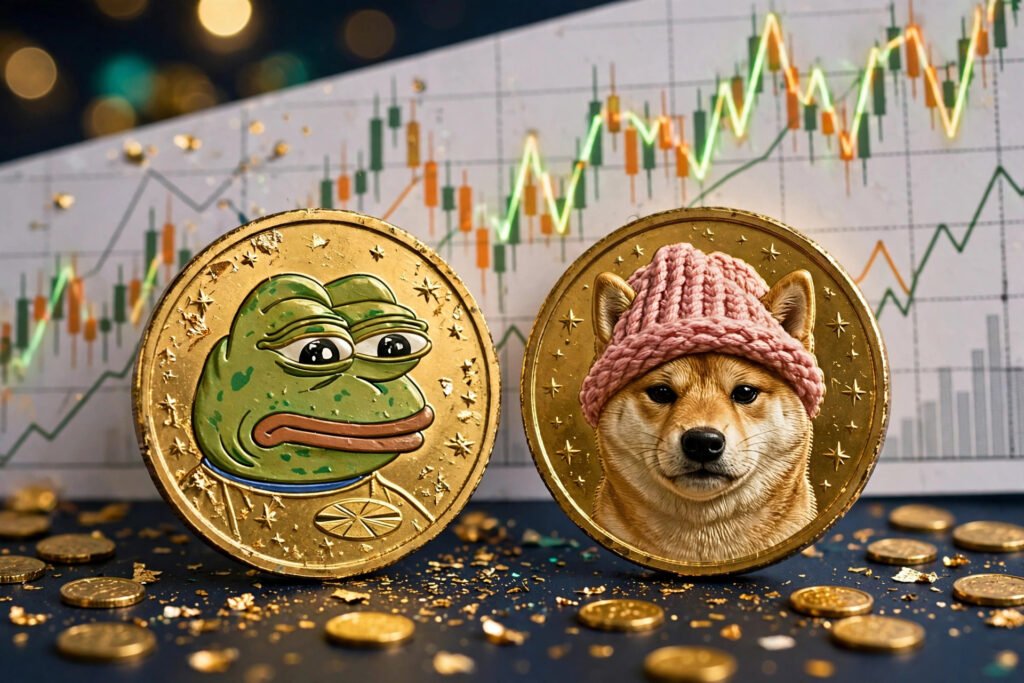
PEPE and WIF in 2026: Meme Coins After the Mania
PEPE and WIF (dogwifhat) are the two meme coins that defined an era — PEPE, the Ethereum-based frog that turned internet culture into a multi-billion-dollar phenomenon in 2023, and WIF, the Solana-based Shiba Inu in a pink knit hat that became the mascot of Solana’s 2024 meme season. As of late October 2026, the mania has cooled: Bitcoin dominance sits near 60%, altcoin liquidity is selective, and the market’s mood (Fear & Greed oscillating between neutral and mild fear) is not the stuff of memecoin euphoria. So where do the two biggest meme coins stand after the mania — and what can they honestly teach us?
What Are PEPE and WIF?
PEPE: the frog
PEPE launched in April 2023 on Ethereum, inspired by Pepe the Frog — Matt Furie’s cartoon character that had spent two decades as one of the internet’s most remixed memes. The token had no utility, no roadmap promises, and no pretense: its website famously disclaimed any intrinsic value. What it had was perfect meme-market fit — a universally recognized character, fair launch mechanics, and timing that caught the post-Bored-Ape appetite for pure culture coins. Within weeks, PEPE reached a market capitalization in the billions, minted a generation of memecoin traders, and proved that in crypto, attention is the scarcest asset.
WIF: the dog with the hat
Dogwifhat (WIF) launched on Solana in late 2023: a Shiba Inu wearing a pink knitted hat, based on a viral photo. Where PEPE was Ethereum’s culture coin, WIF became Solana’s — riding the chain’s 2024 renaissance to become its flagship meme. The community’s crowning cultural moment was crowdfunding a campaign to display the dog on the Las Vegas Sphere, raising hundreds of thousands of dollars purely for the meme of it. Like PEPE, WIF has no utility; its value is 100% social consensus.
How Meme Coins Actually Work (Economically)
Strip away the jokes and meme coins run on a simple, brutal economics:
- Attention in, price up. Memes spread on social media; new buyers arrive; early holders sell into the bid. Price is a function of mindshare velocity.
- Liquidity is the real product. A meme coin with deep liquidity across major exchanges survives; one tradable only on a single DEX dies with the first whale exit. Both PEPE and WIF achieved deep, multi-venue liquidity — their most durable asset.
- Supply is (usually) fixed and fully circulating. No staking yields, no emissions schedules to model — what you see is what there is. This simplicity is a feature: there is no team unlock cliff to fear (though large early holders remain a risk in every meme coin).
- Narrative cycles drive everything. Meme coins pump in waves tied to market-wide risk appetite. When BTC dominance is high and fear prevails — as in October 2026 — meme coins bleed; when speculation returns, they lead.
PEPE vs. WIF: A Tale of Two Ecosystems
| Dimension | PEPE | WIF |
|---|---|---|
| Chain | Ethereum (ERC-20) | Solana (SPL) |
| Launched | April 2023 | Late 2023 |
| Mascot | Pepe the Frog (Matt Furie) | Shiba Inu in a pink hat |
| Utility | None — pure culture | None — pure culture |
| Cultural peak | 2023 Ethereum meme season | 2024 Solana meme season, Sphere campaign |
| Key risk | IP/copyright overhang (Furie) | Solana meme rotation to newer coins |
The 2024–2025 Meme Supercycle: What Happened
The meme coin supercycle was the defining speculative episode of the last market cycle. Launchpads made creating tokens trivial; Solana’s low fees made trading them frictionless; and social media turned every cycle into a casino. Thousands of meme coins launched daily at the peak. The established names — PEPE, WIF, DOGE, SHIB, BONK, FLOKI — consolidated attention while countless imitators went to zero within hours.
The cycle’s anatomy was predictable in retrospect:
- Phase 1 — Innovation: genuinely novel memes with organic communities (WIF’s hat, BONK’s Solana-native distribution).
- Phase 2 — Industrialization: launchpads, sniper bots, and influencer cabals turned memecoins into a professional extraction industry.
- Phase 3 — Celebrity grift: celebrity-endorsed tokens with insider allocations — the phase that drew regulatory attention and burned retail hardest.
- Phase 4 — Exhaustion: liquidity fragmented across infinite supply; even good memes bled as attention scattered.
By 2026, the market has sobered. The survivors — PEPE and WIF among them — are the ones with the deepest liquidity, the strongest communities, and exchange listings that keep them tradable. Everything else was confetti.
Why Meme Coins Keep Coming Back
Skeptics have declared meme coins dead in every cycle, and every cycle they return. The structural reasons:
- Culture is the product. Humans coordinate around shared symbols; tokens monetize that coordination. This predates crypto (sports fandoms, sneaker culture) and will outlast it.
- They are honest speculation. A meme coin promises nothing, which paradoxically makes it more honest than the thousand utility tokens that promised revolutions and delivered nothing. The risk is legible.
- Lottery economics: a small position in a meme coin is a call option on virality. Most expire worthless; a few pay 100x. Retail understands this trade intuitively.
- They onboard users. For all the carnage, meme seasons bring new users into crypto who later discover DeFi, stablecoins, and self-custody. The casino funds the ecosystem’s growth.
The Honest Risks of Meme Coins
Volatility that can erase 90%+ without news
Meme coins routinely draw down 80–95% from peaks. PEPE and WIF both experienced such drawdowns. There is no fundamental floor — no revenue, no yield, no buyback — so “cheap” is meaningless. A meme coin down 90% can fall another 90%.
Insider and early-holder distribution
Every meme coin has early buyers sitting on life-changing multiples. Their selling is constant background pressure, and concentrated holdings mean a single whale’s exit can crater the price. “Community-owned” is often more slogan than reality.
IP and legal risk (PEPE specifically)
Pepe the Frog is Matt Furie’s creation, and he has pursued unauthorized commercial uses before. A meme coin trading on his character exists in a legal gray zone — unlikely to be the SEC’s priority, but not nothing.
Rotation risk (WIF specifically)
Solana’s meme attention is famously fickle — today’s mascot is tomorrow’s has-been. WIF must compete with an endless stream of new Solana memes for the same speculative capital. Past-mascot status is not a moat.
Scams, honeypots, and copycats
For every real PEPE there are a hundred fake PEPES — similar names, similar branding, malicious contracts. September 2026’s $766 million hack month included plenty of meme-adjacent fraud. Never buy a meme coin without verifying the contract address from a trusted source.
Regulatory headline risk
The celebrity-token phase drew real regulatory scrutiny. While established decentralized memes are unlikely targets, the category’s reputation affects exchange listings and institutional comfort.
How to Think About Meme Coins (If You Insist)
This is not an endorsement — it is harm reduction for the inevitable:
- Position sizing is everything. Meme allocations should be money you can lose entirely — lottery tickets, not investments.
- Take profits mechanically. Decide sell levels in advance; euphoria destroys judgment.
- Verify contracts. Copycat tokens are the #1 retail trap.
- Watch liquidity, not price. A rising price on thinning liquidity is a trap; deep liquidity is the only safety feature memes have.
- Beware the round trip. The most common meme-coin outcome is riding a 10x back to zero. Selling half on a double is unglamorous and correct.
Three Scenarios for PEPE and WIF
Bull case: the blue chips of culture
The next speculation wave crowns the survivors: PEPE and WIF, with the deepest liquidity and strongest brands, lead the meme rally as they did before. New exchange listings, cultural moments (another Sphere-scale stunt), and social media cycles drive multiples. They remain the “large caps” of a permanently recurring casino.
Base case: cyclical zombies with pulse
Both tokens trade as high-beta crypto proxies — rallying hard in risk-on rotations (like the Altcoin Season Index’s mid-October rise to 60) and bleeding in defensive markets. Long-term holders oscillate between euphoria and despair; the communities persist; the charts never quite die.
Bear case: replaced and forgotten
New memes capture the culture; liquidity migrates; PEPE and WIF join the long list of former mascots trading at fractions of their peaks with thinning order books. In meme markets, irrelevance is the only true death — and it is permanent.
DOGE and SHIB: The Ancestors
PEPE and WIF didn’t invent meme coins — they inherited the throne. Dogecoin, launched in 2013 as a joke about Bitcoin, became the original meme coin through sheer cultural persistence and, eventually, high-profile endorsements. Shiba Inu (SHIB), launched in 2020, rode the last bull market to a top-ten market cap by building an entire ecosystem (DEX, metaverse ambitions, layer-2) around a dog meme.
The generational pattern is instructive: each cycle’s dominant memes reflect the era’s platforms and humor. DOGE was the forum era; SHIB the influencer era; PEPE the post-NFT irony era; WIF the Solana-casino era. The specific winners rotate, but the slot — “the meme coin everyone knows” — persists. That persistence is the closest thing meme coins have to a fundamental: cultural mindshare compounds across cycles even as individual tokens fade.
BONK and the Solana Meme Ecosystem
No WIF analysis is complete without BONK — the Solana community’s own meme, airdropped broadly to Solana users in late 2022 as a morale boost during the ecosystem’s darkest hour (post-FTX). BONK’s distribution-first launch created a genuinely broad holder base, and its integration into Solana apps (as payments, rewards, and burn mechanics) gave it utility-adjacent staying power.
BONK and WIF illustrate two meme strategies: BONK the insider’s coin (distributed to the faithful, integrated everywhere), WIF the outsider’s coin (pure viral image, no pretense). Both worked. The lesson: there is no single formula — community authenticity, however manufactured, beats marketing budgets. But both also illustrate the ceiling: even the best memes remain high-beta speculation, and Solana’s meme attention has proven brutally rotational.
The Psychology of Meme Trading
Meme coins are a masterclass in behavioral finance. The forces at work:
- Social proof: “everyone is buying” is the entire investment thesis — and in reflexive markets, it temporarily works, which reinforces the behavior.
- Unit bias: owning millions of tokens feels better than owning 0.001 BTC, even at identical dollar values. Meme coins exploit this ruthlessly with huge supplies and tiny unit prices.
- Loss aversion inverted: the pain of selling early and watching a 100x run without you exceeds the pain of losing the stake — so holders ride winners into the ground.
- Narrative over numbers: no earnings, no TVL, no roadmap milestones to disappoint — memes can’t miss expectations because they set none. This makes them psychologically easier to hold than “fundamental” tokens that keep disappointing.
Understanding these mechanics doesn’t make meme trading safe — it makes it legible. The traders who survive meme cycles are the ones who recognize they’re playing a psychology game and size accordingly, not the ones who convince themselves the frog has fundamentals.
The 2026 Meme Coin Landscape: What’s Different Now
The meme market that PEPE and WIF inhabit in late 2026 is not the one they conquered. Several structural changes define the post-mania era:
- Consolidation at the top: attention and liquidity have pooled into a small set of recognized names — the meme “large caps” — while the long tail churns faster than ever. Being established is now a genuine advantage; new memes face a higher bar for breaking through.
- Exchange legitimacy: major regulated exchanges list the top memes, giving them permanence and access to fiat ramps that pure on-chain tokens lack. Delisting risk for PEPE/WIF is low; for the average new meme, it is existential.
- Derivatives markets: perpetual futures on major memes mean traders can short them — a discipline mechanism that didn’t exist in the spot-only era. Funding rates now broadcast meme sentiment quantitatively.
- Institutional tolerance: asset managers openly discuss meme exposure as a portfolio line (usually tiny, usually hedged) — a sentence that would have been unthinkable in 2021.
None of this makes meme coins safe. It makes them established — a permanent asset class within crypto, with PEPE and WIF as two of its founding tickers.
Meme Coin Red Flags: A Field Checklist
Since most readers will encounter new memes rather than the established two, here is the survival checklist:
- Unverified or unverifiable contract address — instant pass.
- Top 10 wallets hold >30% of supply — a rug waiting for a moment.
- Liquidity not locked or burned — the exit door for the deployer.
- Anonymous team + paid celebrity promotion — the extraction playbook, verbatim.
- “Utility coming soon” for a meme — memes don’t need utility; promises are for exit liquidity.
- Buy-only pressure in community channels (sellers banned, questions mocked) — you are the product.
- Sudden volume spikes with no social footprint — wash trading to fake momentum.
Neither PEPE nor WIF trips these flags at scale today — that’s precisely why they survived. The flags aren’t about the past; they’re for the next “PEPE killer” someone pitches you tomorrow.
The Numbers Game: Meme Coin Market Structure
Understanding meme market structure explains why the category behaves as it does. Key features of late-2026 meme markets:
- Concentrated liquidity tiers: the top ~10 memes hold most of the category’s liquidity; beyond that, a steep cliff. Liquidity concentration is why PEPE and WIF survive drawdowns that kill smaller memes outright — there are always buyers, even at 90% down.
- Perpetuals dominance: for large-cap memes, perps volume often exceeds spot, meaning funding rates and liquidation cascades drive short-term moves more than spot buying. Meme traders ignore funding at their peril.
- Exchange flows as signal: large transfers onto exchanges historically precede selling; withdrawals signal holding conviction. On-chain flow watching is the meme trader’s edge — noisy, but better than nothing.
- Volatility clustering: meme volatility comes in episodes — weeks of flat drift, then 50% moves in days. Position sizing must assume the episode, not the drift.
None of this changes the fundamental verdict (memes are speculation), but it explains why the experienced meme traders outperform the tourists: they trade the structure, not the story.
Frequently Asked Questions
What is PEPE?
PEPE is an Ethereum-based meme coin launched in April 2023, inspired by the Pepe the Frog meme. It has no utility or roadmap — its value comes entirely from cultural relevance, community, and trading liquidity.
What is WIF (dogwifhat)?
Dogwifhat is a Solana-based meme coin launched in late 2023, themed on a Shiba Inu wearing a pink knit hat. It became Solana’s flagship meme of the 2024 cycle, famous for its community’s crowdfunded Las Vegas Sphere campaign.
Do meme coins have any utility?
Generally no. PEPE and WIF are pure culture tokens — no staking, no governance with real power, no revenue. Their “utility” is social: coordination, entertainment, and speculation. Anyone claiming otherwise is selling something.
Why do meme coins have value at all?
Attention plus liquidity. A meme that millions recognize, tradable on deep liquid markets, becomes a Schelling point for speculation. Value comes from collective belief and the greater-fool dynamics of viral attention — real economics, just not fundamental economics.
Are meme coins a good investment?
They are among the highest-risk assets in crypto: 90%+ drawdowns are normal, there is no fundamental floor, and most go to zero. If approached at all, they should be tiny, lottery-style positions — never core holdings. This is not financial advice.
How do I avoid fake meme coins?
Always verify the contract address from the project’s official channels or a major exchange listing. Copycats use nearly identical names and branding. Check liquidity depth and holder distribution before buying anything.
Can meme coins go to zero?
Yes — most do. Thousands of meme coins launched in the supercycle are now worthless or illiquid. PEPE and WIF’s deep exchange liquidity makes total collapse less likely in the short term, but “less likely” is not “impossible.” Any meme position can decline 90%+ and may never recover.
Why do new meme coins keep launching?
Because launching one is nearly free and the upside for early insiders is enormous — an asymmetric incentive that guarantees infinite supply of new memes. Launchpads profit regardless of outcomes. This supply flood is exactly why only the established names retain value: scarcity of attention in an ocean of tokens.
PEPE or WIF — which is “better”?
Neither — they’re different expressions of the same speculation: PEPE rides Ethereum’s culture and OG meme status; WIF rides Solana’s trading energy. Both are volatile, fundamentals-free assets. The honest answer is that the better trade depends on timing, sentiment, and luck — not on anything either project can control.
Do PEPE and WIF have official teams?
Both launched with small founding teams that have since stepped back — meme coins are typically community-driven after launch, with no official roadmap, foundation, or customer support. That cuts both ways: no team can rug the treasury, but nobody is accountable for development, listings, or communications either.
This article is for informational purposes only and is not investment advice.