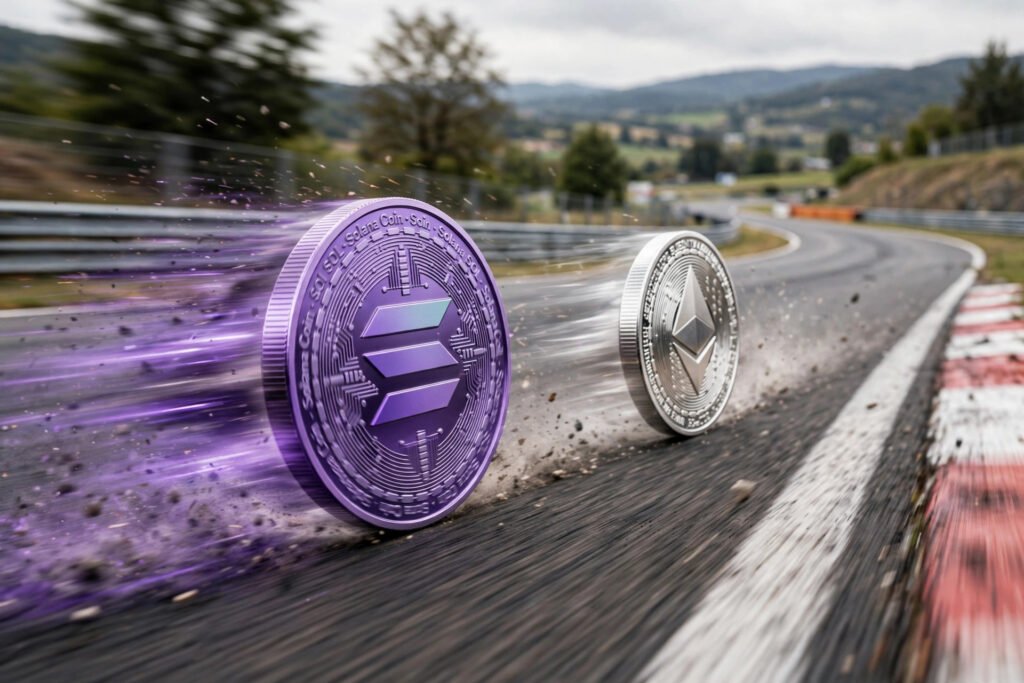
Solana vs Ethereum in 2026: the rivalry that defines smart contracts
No debate in crypto has more history — or more heat — than Solana vs Ethereum. Ethereum is the original smart-contract platform, the settlement layer for decentralized finance and the benchmark every competitor is measured against. Solana is the challenger that rebuilt the stack around raw speed and low fees, winning over developers and users who found Ethereum too expensive to touch. In 2026 the rivalry is less about who “kills” whom and more interesting: two different philosophies about what blockchains should be, both serving real users at real scale.
The macro backdrop matters. As of late October 2026, ETH trades near $2,400 — roughly 49% below its all-time peak of $4,953.73 — and Ethereum‘s ecosystem is mid-upgrade: the Glamsterdam upgrade activated on the Sepolia testnet on October 6, 2026, heads to the Hoodi testnet on October 26, and targets mainnet in Q4 2026. Solana, meanwhile, is consolidating its position with its own ETFs in the market (US spot SOL ETFs saw about $26 million in weekly outflows recently, part of a broad risk-off stretch that also hit ETH ETFs with a record ~$955 million of October outflows). This guide compares the two on fees, speed, decentralization and real usage — and tries to leave tribalism at the door.
The core design difference: monolithic vs modular
At heart, Solana vs Ethereum is a debate between two architectures:
- Solana is monolithic: one high-performance chain handles execution, settlement and data availability together. Consensus, execution and networking were co-designed so that a single chain can process huge transaction volumes directly on layer-1.
- Ethereum is modular: the base layer is deliberately scarce and optimized for security and settlement, while most user activity happens on layer-2 networks (Arbitrum, Base, Optimism and others) that inherit Ethereum’s security. Ethereum keeps the base layer simple; scaling happens above it.
This single choice explains almost everything else. Solana’s approach gives users a unified chain with no bridging between layers — everything lives in one place. Ethereum’s approach gives a secure foundation with a growing family of cheaper execution environments. Neither is “wrong”; they optimize for different things.
Fees: the gap that started the war
Fees are where Solana made its name. A typical Solana transaction costs a tiny fraction of a cent — so small that fees are barely a consideration, and developers can build apps (games, micropayments, social) whose business models would collapse under dollar fees. That low cost is structural: Solana’s design targets massive parallel throughput, so block space rarely becomes scarce enough to price anyone out.
Ethereum mainnet is a different world. Its block space is deliberately scarce, and when demand spikes — an NFT mint, a liquidation cascade, a viral app — fees can swing from reasonable to genuinely painful in minutes. That is exactly why Ethereum’s scaling strategy pushed activity to layer-2s: on Arbitrum, Base or Optimism, transactions typically cost cents, not dollars. But that means the fair comparison is no longer “Solana vs Ethereum mainnet” — it is “Solana vs Ethereum’s L2 family,” where the fee gap narrows dramatically for ordinary users.
Speed and throughput: how the two engines differ
Solana targets sub-second block times and is engineered for very high sustained throughput, using its proof-of-history design to order transactions efficiently and parallel execution (Sealevel) to process non-conflicting transactions simultaneously. The practical result: confirmations feel instant and the network rarely congests from ordinary activity — though it has famously suffered full-network outages under extreme load in the past, a fact critics never let it forget.
Ethereum’s base layer is slower by design — roughly 12-second blocks, with finality measured in minutes — but its layer-2s deliver near-instant user-facing confirmation, settling to Ethereum underneath. Total throughput across Ethereum’s L2 ecosystem is far higher than mainnet’s, and Ethereum’s own upgrades keep pushing that envelope: Glamsterdam’s test blocks ran around 200 million gas versus ~60 million on mainnet, and its enshrined proposer-builder separation and revised gas pricing are aimed at making block space cheaper and fairer for everyone, including rollups.
| Dimension | Solana | Ethereum |
|---|---|---|
| Architecture | Monolithic: one fast chain does it all | Modular: secure base layer + layer-2 execution |
| Layer-1 fees | Typically a fraction of a cent | Can spike; scarce by design |
| Cheap-fee environment | Solana itself | Layer-2 networks (Arbitrum, Base, Optimism) |
| Confirmation feel | Sub-second | Sub-second on L2s; minutes on mainnet |
| Native token use | SOL pays fees and stakes | ETH pays fees and stakes |
| Upgrade path | Incremental client and protocol upgrades | Scheduled upgrades (e.g., Glamsterdam → Hegotá) |
| Downtime history | Notable past outages | Extremely high base-layer uptime record |
Decentralization: the hardest honest comparison
Ethereum is the most decentralized major smart-contract chain by almost every measure that matters: thousands of validators, a globally distributed node set, multiple independent client implementations (no single software monoculture), and a base layer that has run for a decade with an exceptional uptime record. Its modular strategy is itself a decentralization choice — keep the foundation neutral and let experimentation happen at the edges.
Solana’s validator set is far more demanding to run — high-performance hardware, serious bandwidth — which raises the bar for participation and concentrates validation among professional operators. Solana compensates with high Nakamoto-coefficient claims and geographic spread, and its client diversity has improved (with Firedancer-class clients maturing), but the honest summary is that Solana trades some decentralization margin for performance. Users who treat Solana like a tech product are fine with that; users who treat blockchains as censorship-resistant settlement infrastructure notice it.
Real usage: what people actually do on each chain
On Ethereum (base + L2s): institutional DeFi, tokenized treasuries and real-world assets, stablecoin settlement at scale, liquid staking, NFT blue chips and most regulated or semi-regulated crypto activity. Its moats are trust, liquidity depth and network effects: the deepest lending markets, the most audited contracts, the widest institutional comfort.
On Solana: high-frequency retail trading, memecoins and launchpads, payments experiments, consumer apps and anything needing sub-cent fees at scale. Its moats are speed, cost and developer experience — a single-chain environment where composability doesn’t require bridging.
Notice the overlap: both run serious DeFi, both host stablecoins, both have NFT scenes. The difference is emphasis and user profile, not capability. And both face the same market weather — October 2026’s risk-off stretch, with ~$1 billion in crypto liquidations in one flush and Fear & Greed readings between 42 and 53, hit ETH and SOL alike, because macro fear does not check your consensus mechanism.
The 2026 state of play: what is new
- Ethereum’s upgrade pipeline is moving. Glamsterdam (enshrined proposer-builder separation, block-level access lists, revised gas pricing) is the current act, with Hegotá planned for 2027. If execution stays on track, Ethereum mainnet becomes more predictable and L2 economics improve with it.
- Solana’s institutional footprint is growing. Spot SOL ETFs exist in the US — a milestone that once seemed far off — even if recent flows have been negative during the risk-off stretch.
- The app layer is converging. Wallets abstract chains, bridges are improving, and stablecoins make both ecosystems usable with dollars. The chain war is increasingly invisible to end users — exactly as it should be.
- Security keeps everyone humble. September 2026 was the worst hacking month of 2026 (~$766M stolen), and the damage respected no chain: the lesson, repeated, is that app and custody security matter more than your choice of layer-1.
Which should you use? A decision framework, not a verdict
- Start from the app, not the chain. The lending market, exchange, game or wallet you want usually exists in one ecosystem. Follow the app.
- Match cost to activity. If you make hundreds of small transactions, Solana’s sub-cent fees are a real advantage. If you move large size infrequently, Ethereum’s liquidity and security depth matter more.
- Match values to architecture. Maximum decentralization and censorship resistance? Ethereum’s base layer is the benchmark. Unified speed and simplicity? Solana’s pitch.
- Use Ethereum’s L2s when mainnet fees bite. Arbitrum, Base and Optimism are where most Ethereum activity lives now — choosing “Ethereum” usually means choosing a layer-2.
- Diversify custody habits, not just chains. Hardware wallets, verified contracts and address-checking discipline protect you equally on both.
Developer ecosystems: where the builders actually are
Ask not which chain is “better”; ask where you’d hire. Ethereum’s ecosystem is the industry’s default: the largest developer community, the deepest library of audited contract templates, multiple client implementations, and — through its layer-2s — a constellation of execution environments (Arbitrum, Base, Optimism and dozens more) all reachable with the same Solidity skills. A security auditor, a grants program, a battle-tested multisig: on Ethereum, these are commodities.
Solana’s developer story is younger but distinctive. Its programming model (Rust-based, with a parallel runtime) rewards performance engineering and attracts builders from gaming, high-frequency trading and consumer apps who find Ethereum’s model constraining. The tooling has matured fast, documentation has caught up, and Solana hackathons funnel a steady stream of consumer-facing startups. Its weakness is concentration: a smaller auditor pool, fewer client implementations (though improving), and a developer culture more dependent on a few core teams. For a founder in 2026, the practical difference: Ethereum offers the widest surface of reusable infrastructure; Solana offers the tightest integration between chain and app performance. Both are rational choices, which is why the tribal framing is so useless.
Stablecoins and payments: the use case both chains are winning
If there’s a killer app both networks share, it’s stablecoin payments. Dollar tokens move on Solana and Ethereum (plus its L2s) at costs and speeds that make legacy rails look antique, and the market is enormous — Tether’s USDT alone is ~$185 billion as of late October 2026. The usage profiles differ by chain topology: Solana’s unified chain and sub-cent fees suit high-frequency, small-value transfers — remittances, merchant payments, app-internal money — while Ethereum’s ecosystem (base layer for large settlement, L2s for retail) hosts the bulk of stablecoin value and the institutional on/off-ramps, including tokenized Treasury products that are, in effect, yield-bearing stablecoins (XRP Ledger RWA volume of ~$7.03B shows this pattern spreading beyond both chains, too).
For payments, users should care about three mundane things more than ideology: does the recipient’s app support the chain, are there liquid off-ramps where the money lands, and does the wallet make address-checking foolproof (a wrong-network transfer is the most common way beginners lose funds between these two ecosystems). On all three counts the gap between Solana and Ethereum is operational, not philosophical.
Validator economics and the cost of running the networks
Under the hood, the two chains make opposite cost trades. Ethereum validators run on modest hardware by design — the point is that anyone, anywhere, can validate, which is why its validator set is vast and geographically dispersed. The cost is paid in throughput: modest hardware means modest capacity at layer-1, hence the rollup strategy. Solana validators run serious machines: high-core-count servers, large memory, and fat network pipes, with costs that push validation toward professionals and data centers. The benefit is the chain’s headline performance; the cost is an ongoing debate about how decentralized a network can be when participating is a business expense.
Solana’s counterargument deserves air: what matters is not who could run a node but the effective distribution of stake and the number of independent entities needed to compromise the network (its Nakamoto coefficient), and on those measures Solana defends itself respectably. Ethereum’s counter-counterargument: client diversity and home validation are insurance you only appreciate during a crisis. Both are reasoning in good faith about different failure modes — performance failure versus capture failure — and your own risk model should decide which you fear more.
The ETF era: both chains are now portfolio assets
A structural change unites the rivals in 2026: both ETH and SOL now sit inside US-listed ETFs, retirement accounts and model portfolios. That changes the user base (from crypto natives to allocators), the flow dynamics (rebalancing, creations and redemptions on market hours), and the discourse (quarterly flows over daily narratives). Recent flow data shows the adjustment is bumpy — ETH ETFs just posted a record ~$955 million October outflow month and SOL ETFs around $26 million of weekly outflows in a risk-off stretch — but the wrappers are permanent now. For the Solana vs Ethereum question, the ETF era adds a new axis entirely: not which chain your apps use, but which asset your portfolio holds, and increasingly the answer from allocators is “both, sized by role” — ETH as the established smart-contract blue chip, SOL as the higher-beta growth position.
Scorecard by use case: who is winning what
Grand unified verdicts are worthless in this rivalry; use-case verdicts are not. Deep DeFi and institutional lending: Ethereum — the deepest pools, the most audited code, the tokenized-Treasury scene, and layer-2s for the retail layer. High-frequency retail trading and memecoins: Solana — sub-cent fees and a unified mempool where speed wins. Payments and remittances: split — Solana for small, frequent transfers; Ethereum’s L2s where the sender and receiver are already inside its wallet ecosystem. NFTs: Ethereum keeps the blue-chip art and collectibles; Solana takes the high-volume, low-price end. Gaming and consumer apps: Solana’s performance story leads, with Ethereum’s app-chains (dedicated L2s/L3s) closing fast. Maximum censorship resistance: Ethereum mainnet, and it isn’t close — ten years of battle-testing shows.
Two honest caveats before you tattoo any of this. First, these leads churn: a single upgrade (Ethereum’s Glamsterdam lands mainnet in Q4 2026 if testing holds; Solana’s client upgrades keep shipping) can redraw a category in a quarter. Second, the user’s real chain is usually chosen by the app and the wallet, and increasingly abstracted away entirely — stablecoin senders pick “the cheap fast one my app defaults to,” and the rivalry becomes invisible plumbing. That convergence, more than any knockout, is the mature state of Solana vs Ethereum: two engines, one market, and a shrinking number of reasons for ordinary users to care which one is under the hood.
A final consideration: what would change the comparison
Comparisons age, and this one has known expiry triggers. If Ethereum’s Glamsterdam upgrade (Hoodi testnet October 26, mainnet targeted Q4 2026) delivers cheaper, more predictable block space, its L2 advantage compounds and Solana’s fee edge narrows further. If Solana’s next-generation clients deliver another step-change in throughput and stability, the performance gap reopens. And if either chain suffers a catastrophic security or liveness failure — in a year when roughly $766 million was stolen in a single month across the industry — the trust premium reprices overnight. The wise approach is to hold this comparison the way both ecosystems hold their roadmaps: as a living document, re-checked against shipped upgrades and real usage rather than inherited from the last cycle’s slogans.
The healthiest mental model, then, is portfolio thinking: use each chain for what it demonstrably does best, keep custody discipline chain-agnostic, and let the upgrades — Glamsterdam now, whatever follows next — speak through shipped code rather than roadmap promises. In a market defined by narratives, the networks that keep working are the only thesis that compounds.
Frequently Asked Questions
Is Solana better than Ethereum?
Neither is categorically better — they optimize differently. Solana is faster and cheaper on layer-1, with a unified chain and sub-cent fees. Ethereum is more decentralized with deeper institutional liquidity, and its layer-2 networks deliver similarly cheap, fast transactions. The right choice depends on what you do: high-frequency small transactions favor Solana; large-size DeFi and maximum decentralization favor Ethereum.
Why are Ethereum fees so high?
Ethereum mainnet block space is deliberately scarce — that scarcity is what keeps the base layer secure and decentralized. High fees during congestion are the signal that demand exceeds that scarce space. Ethereum’s answer is its layer-2 networks (Arbitrum, Base, Optimism), where fees are typically cents, and ongoing upgrades like Glamsterdam that make block space more predictable.
Has Solana had outages?
Yes — Solana has suffered several notable full-network outages in past years under extreme load, which remains its most-cited weakness versus Ethereum’s base-layer uptime record. Solana has since improved client diversity and stability, but the history is part of an honest comparison.
What is Glamsterdam and does it affect Solana?
Glamsterdam is Ethereum’s current upgrade: it activated on the Sepolia testnet on October 6, 2026 (with test blocks around 200M gas versus ~60M on mainnet), moves to the Hoodi testnet on October 26, and targets mainnet in Q4 2026. It brings enshrined proposer-builder separation and revised gas pricing. It doesn’t change Solana directly, but it improves Ethereum’s competitiveness and L2 economics.
Can I hold both ETH and SOL?
Yes — many users hold and use both, since they serve different niches. Just size each position by conviction, keep custody habits consistent (hardware wallets, verified addresses), and remember both assets are volatile: ETH is about 49% below its peak and the whole market sits roughly 36% below Bitcoin’s all-time high as of late October 2026.
This article is for informational purposes only and is not investment advice. Crypto markets are volatile — always do your own research.