
A small online shop owner once tried to stop spam comments by writing rules by hand: block any comment with a link, block certain words, block comments posted too quickly. It worked for a week. Then genuine customers got blocked, spammers changed their wording, and the rule list grew into a mess nobody could maintain. That failure is the perfect starting point: instead of writing every rule yourself, you let a system learn the patterns from examples.
In short, machine learning is a method where a computer improves at a task by learning from data, rather than by following only instructions a programmer wrote in advance. You feed it examples, it finds data patterns, and it builds a machine learning model that can make a prediction about new, unseen examples.
Table of Contents
How Machine Learning Differs From Traditional Programming
Traditional programming and machine learning solve problems in opposite directions. In traditional programming, a person writes the rules and the computer follows them exactly. In machine learning, a person supplies examples and a goal, and the computer works out useful rules of its own — important because many real problems have too many exceptions for hand-written rules.
| Approach | Who writes the rules? | Best when | Weakness |
|---|---|---|---|
| Traditional programming | The programmer | Rules are clear and stable | Breaks when cases change |
| Machine learning | The system, from examples | Patterns are complex or shifting | Needs good data and testing |
Think of it this way. An algorithm is a set of steps for solving a problem. In machine learning, algorithm training means the algorithm adjusts itself as it sees more training data, so its behaviour is shaped by evidence rather than by one person’s guesses. That is why it can fail badly when examples are biased, incomplete, or badly labelled.
Machine learning is part of artificial intelligence, but the terms are not identical. Artificial intelligence is the broad goal of making computers do tasks that normally need human intelligence; machine learning is one route to it, by learning from data. Deep learning is a narrower branch using large, layered networks called neural networks. If you search for “machine learning vs AI”, remember this nesting: AI is the umbrella, machine learning sits under it, and deep learning sits under machine learning.
How Does Machine Learning Work?
A machine learning project usually follows the same five steps, whether the goal is filtering spam, forecasting demand, or recognising handwriting.
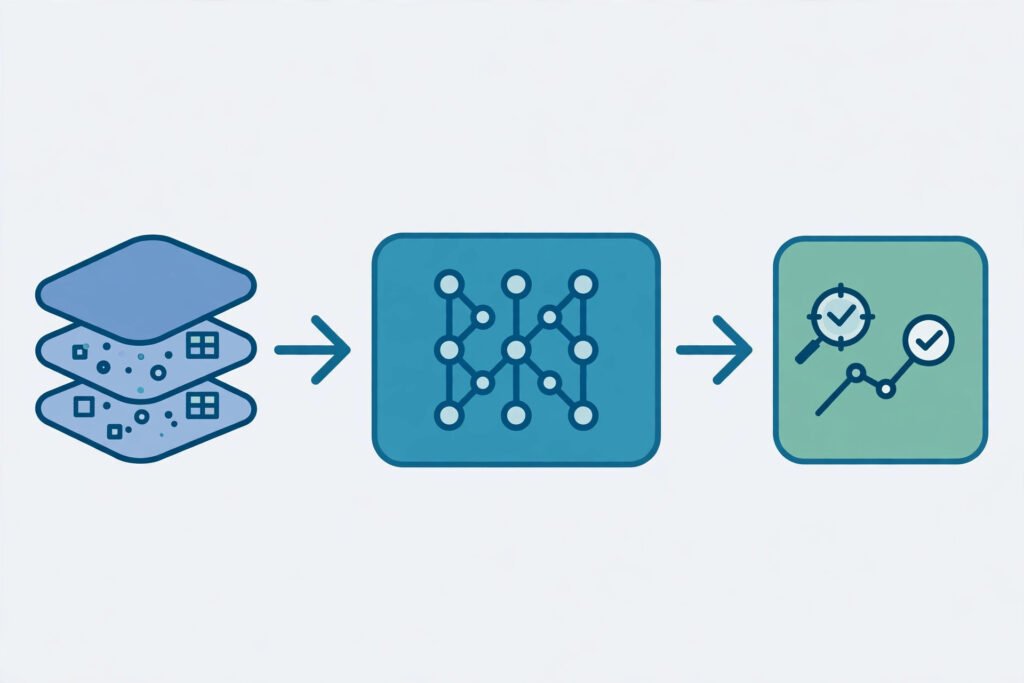
1. Define the task and gather training data. The task must be specific: “flag spam comments” is workable, “make the website better” is not. Then collect examples showing both outcomes, such as genuine comments and spam comments.
2. Choose the features. Feature engineering means deciding which details the model may use. For a spam filter, useful features include the presence of a link, the sender’s history, and the time of posting. Good features matter more than fancy methods: a model fed irrelevant details learns irrelevant lessons.
3. Train the model. Training means showing the model the examples and letting it adjust its internal settings to reduce its errors. A decision tree learns a series of yes-or-no splits — does the comment contain a link, was the account created today — while a random forest combines many such trees and lets them vote, which usually makes the result steadier.
4. Test on unseen data. Testing on the same data a model trained on proves only that it can memorise, not that it can generalise. Model accuracy on a held-out test set is a far more honest measure, and it should be checked across different groups of users, not just on average.
5. Deploy, monitor, and retrain. Real data changes: spammers adapt, tastes shift, and language evolves. A model that is never monitored slowly drifts out of date, so good teams watch its predictions, collect fresh examples, and retrain on a schedule.
Types of Machine Learning
There are three main types of machine learning, and the difference comes down to what kind of feedback the system gets.

Supervised learning uses labelled examples: each input comes with the correct answer. Showing thousands of emails labelled “spam” or “not spam” is supervised learning, used for classification and for numerical prediction, such as estimating a delivery time.
Unsupervised learning uses unlabelled data: there are no correct answers, only structure to discover. A shop might use it to group customers with similar buying habits, without deciding the groups in advance.
Reinforcement learning learns by trial and feedback. An agent takes actions, receives rewards or penalties, and gradually learns a strategy that earns the most reward over time. It is used in game playing and some robotics problems, where the right answer cannot simply be looked up in a labelled dataset.
Machine learning algorithms also differ in computing needs: a simple model may run on an ordinary laptop, while deep learning with a large neural network may need a graphics processing unit (GPU) to train in reasonable time. The simplest model that solves the problem well is usually the right choice.
A Worked Example: Building a Spam Filter
Imagine you run a blog that receives 1,000 comments a week, and about 200 are spam. You already have a year of comments, each marked by a moderator as genuine or spam. That labelled history is your training data.
First, you turn each comment into features: does it contain a link, how many words does it have, does it repeat the same phrase, is the sender new, and was it posted within seconds of account creation? Next, you train a model on most of the history and keep the newest month aside for testing. Suppose the model flags 190 of the 200 spam comments in the test month, but also flags 10 genuine comments. Its overall accuracy looks high, because most comments are genuine, yet those 10 false alarms are the real cost: real readers silenced by mistake.
So you adjust: you add a feature — whether the sender has commented successfully before — and send borderline comments to moderation instead of deleting them outright. After retraining, the model flags 185 spam comments and only 2 genuine ones, and a human reviews the uncertain cases. That design is typical of real world machine learning: automation does the heavy lifting, and a human handles edge cases where a mistake is expensive. The benefits of machine learning here are not perfection, but consistency, speed, and tirelessness at a scale no moderator could match alone.
Machine Learning Examples in Everyday Life
Machine learning examples surround you, often invisibly. When Google ranks results, Netflix suggests a film, or Amazon recommends a product, a model has learned from search, viewing, and buying patterns. When a photo app groups pictures of the same person, that is computer vision, the branch that interprets images. When a phone keyboard predicts your next word, or a chatbot drafts a reply, that is natural language processing, the branch concerned with human language.
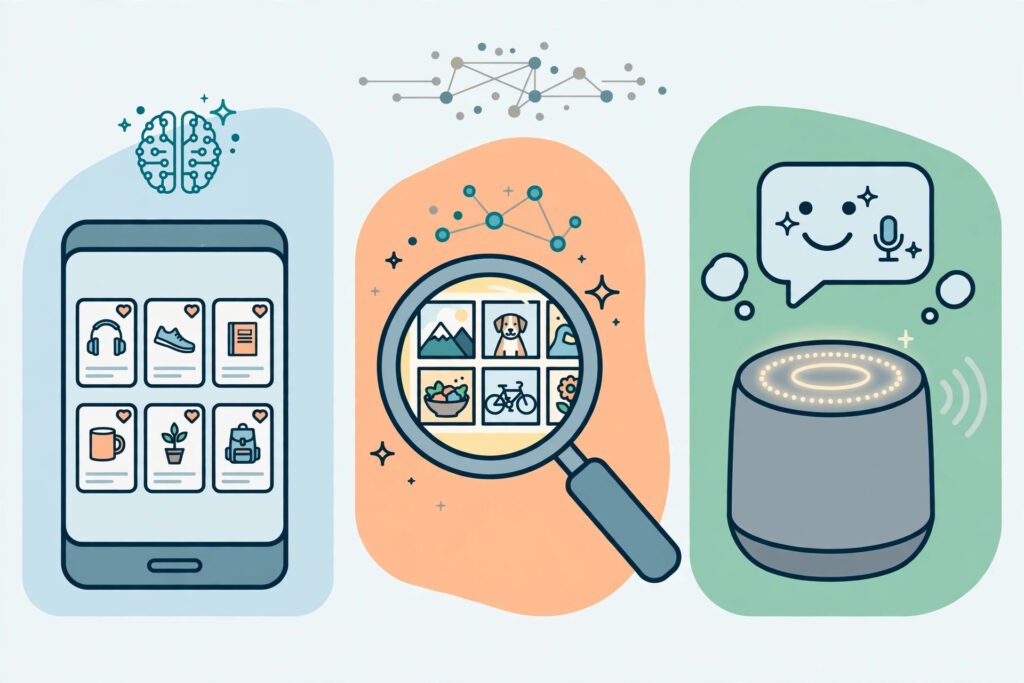
Other everyday uses include predictive analytics in business — forecasting demand, spotting unusual transactions that may indicate fraud, and predicting which machines may need maintenance. The common thread is pattern recognition at a scale, speed, or consistency that manual rules cannot reach.
Tools make this work accessible. Python is the most popular language for machine learning, with libraries such as scikit-learn for classic models and TensorFlow for neural networks. OpenAI and other research organisations publish models developers build on, but the discipline is the same: data, features, training, testing, and honest evaluation.
Common Mistakes in Machine Learning
Trusting accuracy alone. If 95 out of 100 cases belong to one category, a lazy model that always guesses that category scores 95 percent and learns nothing. Look at the mistakes, not just the headline score.
Training on dirty or biased data. A model learns whatever the data teaches. If past decisions were unfair or unrepresentative, it will reproduce that bias at scale. Checking who is missing from the data is part of the job.
Leaking the answer. If a feature contains information unavailable at prediction time — for example, a “resolved” flag on a ticket you are trying to predict — the model looks brilliant in testing and useless in practice.
Overfitting. A model that memorises its training examples, including their noise, performs worse on new data. Simpler models, more data, and proper testing help.
Skipping the human step. Fully automatic decisions about hiring, lending, or medical care carry real consequences. The safest designs keep a human in the loop for high-stakes calls.
Expecting magic from small data. Deep learning needs large, well-labelled datasets. With a few hundred examples, a simple model and careful feature engineering will usually beat a giant neural network.
Your Practical Checklist: Learn Machine Learning the Right Way
If you want to learn machine learning rather than just read about it:
- Learn basic Python and how to work with tables of data.
- Study one supervised method properly — a decision tree is a good first choice — before touching neural networks.
- Build a small project end to end: collect data, train, test on unseen examples, and write down where the model fails.
- Learn how to split data, measure errors honestly, and explain a prediction in plain language.
- Only then explore deep learning and neural networks, starting with a problem where they genuinely help, such as images or text.
- Keep a notebook of mistakes: every failed model teaches more than a perfect demo.
What to do next depends on your goal. If you are choosing a career direction, data science roles reward statistics and communication as much as coding. If you are a business owner, start with one repetitive decision you already make from examples — sorting enquiries or forecasting stock — and ask whether a small, well-tested model could assist a human, not replace them.
Related Reading
Frequently Asked Questions
What is machine learning in simple words?
Machine learning is a way of building software that learns from examples. Instead of a programmer writing every rule, the system studies data, finds patterns, and uses them to make predictions about new cases.
How does machine learning work, step by step?
Define a task, gather training data, choose features, train a model by letting it reduce its errors, test it on unseen data, then monitor and retrain it as data changes.
What is the difference between machine learning and artificial intelligence?
Artificial intelligence is the broad field of making computers perform tasks needing human-like intelligence. Machine learning is one approach within it, based on learning from data. Deep learning uses layered neural networks.
Do I need to know advanced maths to learn machine learning?
Not to start. Basic comfort with averages, graphs, and simple algebra is enough for a first project with modern libraries. Deeper maths helps later, when you want to understand why a model behaves as it does.
Can machine learning work with a small amount of data?
Sometimes, with a simple model and well-chosen features. But machine learning is only as good as its examples: tiny, noisy, or biased datasets produce unreliable models, and then a hand-written rule may be better.